by Zach Crain
“He marked for me the Circle, made magic in my eyes;
he won me by revealing the truth in all his lies.
So, when I see that Wizard among the marchers dim,
I make the full court curtsy, in fealty to him!”
— Adapted from Nathalia Clara Ruth Crane,
The Janitor’s Boy and Other Poems (Thomas Seltzer, 1924)
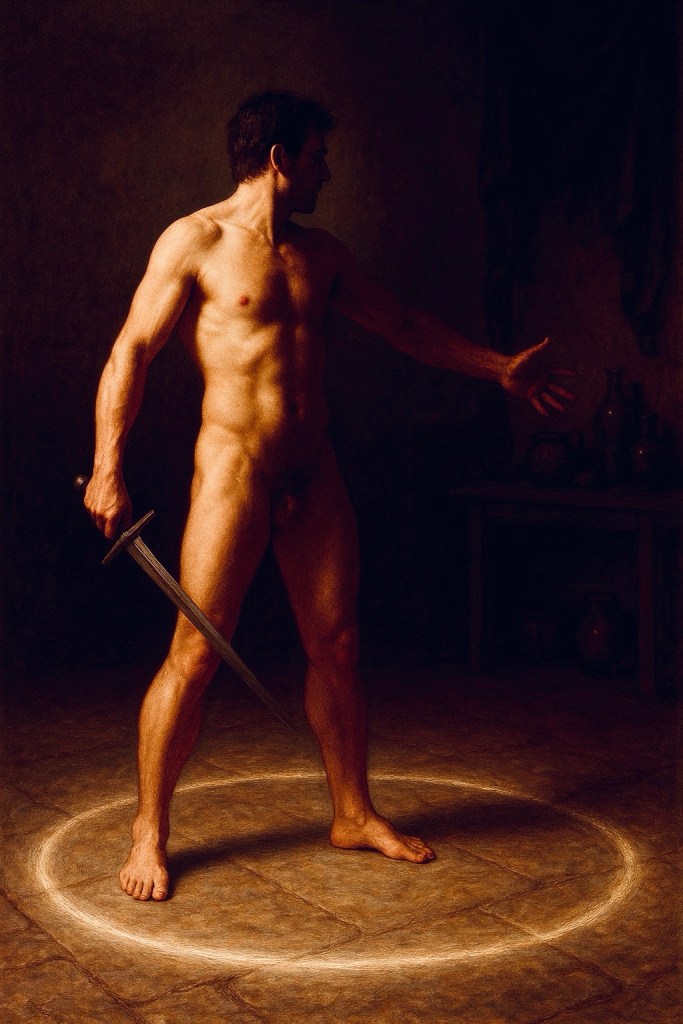
There is something provocative (even dangerous) about the image of a Skyclad man holding the sword at the edge of the Circle.
In our contemporary Craft, so much ink is (rightfully) spilled on the Priestess: her beauty, her power, her role as vessel and voice of the Goddess. But what of the man beside her? The one who speaks the word, bears the blade, holds the incense at the quarters? What of the Wizard, not the grandstanding sorcerer or the Instagram caricature, but the liminal, devoted, initiated Witch?
This isn’t a manifesto. It’s a challenge. A meditation of sorts. A call to reconsider what we’ve assumed and perhaps what we may have lost.
Wicca and Wicce: Before the Binary
Long before “Wiccan” became the catch-all term for modern practitioners, the Old English language gave us two words: Wicca (masculine) and Wicce (feminine). Both stem from a root meaning “to bend or shape” suggesting a person who bends reality, reshapes fate, wields will. This was not about hierarchy. It was about craft.
And yet, somewhere along the modern timeline, these terms have collapsed into a single gender-neutral identity. In doing so, we may have unknowingly erased something. Not just a title, a role. A path. A priesthood.
Ask yourself: If Wicce is celebrated in her fullness, why is Wicca sometimes regarded as suspect?
The Man in Black: Devil, Priest, or Something Else?
The image of the Man in Black is older than Gardner. Older than Murray. He prowls the edges of folk memory, a shapeshifter, sometimes a devil, sometimes a healer, often feared. Margaret Murray (flawed though her scholarship may be) preserved a cultural “truth” in her theory: that the “Devil” at the Sabbat may not have been infernal at all, but simply a man performing priesthood in the Old Ways.
Does the fear still linger?
When a man casts the Circle, invokes the Goddess, or speaks prophecy, is there an unspoken suspicion? A hesitation to let him stand in his fullness as Witch?
We must ask and answer honestly, why that is.
“He Marked for Me the Circle”: Rethinking the Magus
The poem above speaks of revelation through paradox. The man who “marked the Circle” is not a tyrant. He is not a thief of the Mysteries. He is the catalyst. The initiate who initiates. The one who bends the unseen into shape and makes the divine intelligible not through explanation, but through presence.
Why, then, has his image become ghosted in many discussions of modern Witchcraft?
Perhaps because we’ve confused masculine roles with patriarchal ones. The former can be sacred. The latter should be dismantled. But the two are not synonymous and the Craft should know the difference.
The Male Cast Circle: A Vanishing Act?
In many modern Covens, men serve… but often as secondaries. Supporters. Squires to the Witch Queen’s crown. But the traditional liturgy tells another story of partnership, polarity, mirroring.
If a Priest is no longer taught to cast the Circle, speak the words of power, or invoke the Goddess with full authority, then what are we preserving?
Adaptation is sacred. Evolution is essential. But erasure is neither.
Witch, Not Warlock: Let’s Be Precise
We must also be clear: the man who walks this path is a Witch. Not a “warlock”, not a “wizard” in the fantasy sense (though folklore may cloak him in that robe) but a Witch: oathbound, Circle-forged, in service to the Gods.
Rather than asking men, “Do you love the Goddess?” we might also dare to ask: “Does the Goddess honour you?” That’s the deeper test, isn’t it? Are you chosen? Are you devoted? Are you fit to serve?
This is not a matter of gender or sexuality. It is a matter of integrity.
Balance Is Not Binary
The future of the Craft includes many voices (queer, trans, non-binary, intersex, masculine, feminine, fluid. This is right and good and necessary. But as we broaden the Circle, let us not forget those who have always had a place in it) the men who walk the traditional masculine current, not in ego, but in service.
The Priest is not obsolete. He is the one who holds the current when no one else can. He is the hand that steadies the blade. The arms that raise the Priestess to the sky.
Not all men are called to that role. But some are. And when they are we must make room.
A Final Gesture: The Full Court Curtsy
So, when you see him (the one standing Skyclad, silent at the edge, bearing the sword and the burden) do not dismiss him.
Watch.
Listen.
And perhaps, if your heart stirs, make the full court curtsy, not in submission, but in recognition. Of balance. Of mystery. Of shared power.
After all, the Gods require servants of all kinds. And the Circle has never been meant to be cast by one alone.
Further Reading:
• Hutton, Ronald. The Triumph of the Moon: A History of Modern Pagan Witchcraft. Oxford University Press, 1999.
• Valiente, Doreen. Witchcraft for Tomorrow. Phoenix Publishing, 1978.
• Murray, Margaret. The Witch-Cult in Western Europe. Oxford University Press, 1921.
• Williams, Raymond. Keywords: A Vocabulary of Culture and Society. Oxford University Press, 1983.
• Gardner, Gerald. Witchcraft Today. Rider & Co., 1954.
• Crane, Nathalia. The Janitor’s Boy and Other Poems. Thomas Seltzer, 1924.
 A Witch Called By Love