From time to time, Gardnerian Witchcraft is described as a religion centered on death and rebirth. This claim is usually rooted in personal interpretation and presented as though it were an objective description of the tradition itself. Personal gnosis is inevitable and valuable, but problems arise when individual conclusions are treated as authoritative and imposed on others as if disagreement indicates misunderstanding.
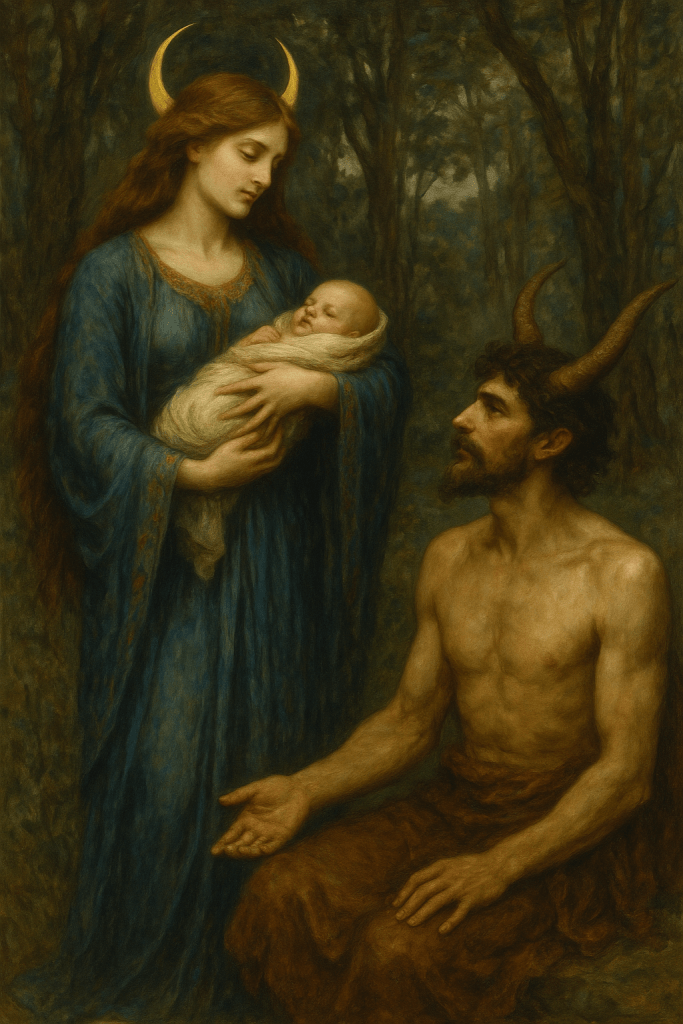
Death and renewal do exist within Gardnerian symbolism. The Horned God’s seasonal pattern: his birth, decline, death, and return, is a genuine mystery of the Craft. But Gardnerian Witchcraft does not begin with death. It begins with continuity. The Great Goddess is eternal, generative, and ever-present. All cycles unfold within Her, not apart from Her. The God governs thresholds and transformation; the Goddess sustains existence itself. A framework that elevates death and reincarnation while minimizing the Goddess removes the very ground that gives the cycle meaning.
The structure of the tradition makes this emphasis unmistakable. When the rites are examined: initiations, Sabbats, Esbats, and formal workings, the majority are oriented toward the Goddess. The thirteen lunar Esbats alone are acts of devotion to Her. This is not incidental. Gardnerian Witchcraft is built upon feminine divinity and embodied life-force. The authority of the High Priestess is theological, not symbolic. Death is honored, but it is not the organizing principle of the religion.
At the same time, the Craft cannot be reduced to fertility alone. When attention collapses into a single theme, whether death or life, the relationship between forces disappears. Power in the Craft emerges through interaction, not isolation.
The Mysteries stay alive through disciplined curiosity, through examining how these forces meet, shape one another, and move through the world. This emphasis on inquiry and exploration is something the Alexandrian current has long understood well.
This is why debates over belief (particularly around reincarnation) are so misplaced. Reincarnation is a belief, not a requirement. Traditional Witchcraft is not an orthodoxic religion, and it was never meant to prescribe conclusions. The initiatory process exists precisely because answers are not handed down in advance. Once belief is mandated, the journey ends.
What seems to be happening instead is a very human impulse toward certainty. People gravitate toward the aspects of the Craft that feel most comfortable or affirming and attempt to organize identity and authority around them. Labels provide clarity and belonging, but when they are imposed on a tradition intentionally left open, they undermine the Mysteries themselves.
The real question is not whether Gardnerian Witchcraft emphasizes life or death. It holds both. The question is why there is such urgency to define, classify, and close what was deliberately left unlabeled. The Craft was never meant to be reduced to slogans or positions. It survives through openness, restraint, and a willingness to let the Mysteries remain unresolved.
That, more than any theological preference, is what is at stake.
 A Witch Called By Love