Traditional Initiatory Witchcraft, particularly as it exists within oathbound lineages, is often misunderstood as a purely folk or revivalist religion. Yet beneath its ritual forms lies a sophisticated metaphysical structure that aligns closely with Neoplatonic philosophy, especially in its understanding of divine emanation, hierarchical reality, levels of consciousness, and theurgic ascent.
Neoplatonism offers a language through which the inner logic of the Craft can be articulated without reducing it to psychology, symbolism, or social custom. When examined carefully, the initiatory system reveals itself not merely as inherited ritual, but as a lived metaphysical path aimed at reintegration with the Source.
In Neoplatonism, truth is not validated by uninterrupted historical documentation but by participation in eternal forms. The Good, the One, or the First Principle exists outside of time, traditions aligned with it recur whenever conditions permit.
Traditional Initiatory Witchcraft understands Ancient Provenance in precisely this sense. Its antiquity does not rest upon an unbroken chain of paperwork, but upon the reemergence of perennial patterns: Priesthood, polarity, ecstatic union, sacramental sexuality, ritual death and rebirth, and direct communion with Divine powers.
In my experience, the Craft does not claim to be unchanged since prehistory, rather, it claims to be reanchored repeatedly in the same metaphysical realities. This is consistent with the Neoplatonic idea that eternal truths descend into time through material vessels, each shaped by culture but animated by the same divine principles.
Within a Neoplatonic framework, the Horned God and Moon Goddess are not merely anthropomorphic deities, nor are they psychological archetypes. They are primary emanations, intelligible principles expressing polarity within manifestation.
The Horned God corresponds to the dynamic, generative, animating force: life, death, sacrifice, ecstasy, and return. He is the moving current, the ensouling power that descends into matter and rises again.
The Moon Goddess embodies receptivity, reflection, containment, and cyclic order. She is the mediating vessel through which divine force becomes knowable, measurable, and ritually accessible.
In Neoplatonic terms, these are hypostases that stand between the ineffable Source and the material world. They are not rivals, but complementary expressions of the same originating unity. Their polarity is not opposition but tension, the necessary condition for manifestation.
The rite of Drawing Down the Moon is best understood as a form of theurgy, the sacred art of invoking Divine presence so that the human soul may ascend by participation.
In Neoplatonism, theurgy is not symbolic roleplay. It is a realignment of the soul with higher realities through ritual, gesture, word, and consecrated space. When the Priestess draws down the Goddess, she does not become the Deity in an absolute sense, rather, she becomes a transparent vessel through which the divine intellect may descend into embodied expression.
This descent is mirrored by ascent. As the divine presence fills the Priestess, the assembled Coven is lifted toward a higher mode of consciousness. The ritual moment collapses the distance between realms, creating a temporary axis through which communion occurs.
Thus, Drawing Down the Moon enacts the Neoplatonic cycle:
Emanation (the Goddess descends).
Participation (the Priestess receives).
Return (the Coven is elevated toward the Source).
In my opinion, Traditional Initiatory Witchcraft affirms a plurality of planes, layered realms of existence that interpenetrate the material world. This view aligns closely with Neoplatonic cosmology, which posits multiple ontological levels between the One and matter.
Within this structure, the Watchtowers, Kings of the Elements, and Elementals are not metaphorical tools. They are intelligences proper to their respective realms.
The Lords of the Watchtowers function as governing intelligences at the thresholds between planes, stabilizing the ritual space as a microcosm.
The Kings of the Elements represent ordering principles, intellective forces that structure earth, air, fire, and water.
Elementals are the most immediate expressions of these forces within the subtle world, operating closer to material manifestation.
Neoplatonically speaking, these beings occupy intermediary levels of reality. They are neither purely intellectual nor purely material, but ensouled. Ritual engagement with them trains the initiate’s perception to operate across ontological boundaries.
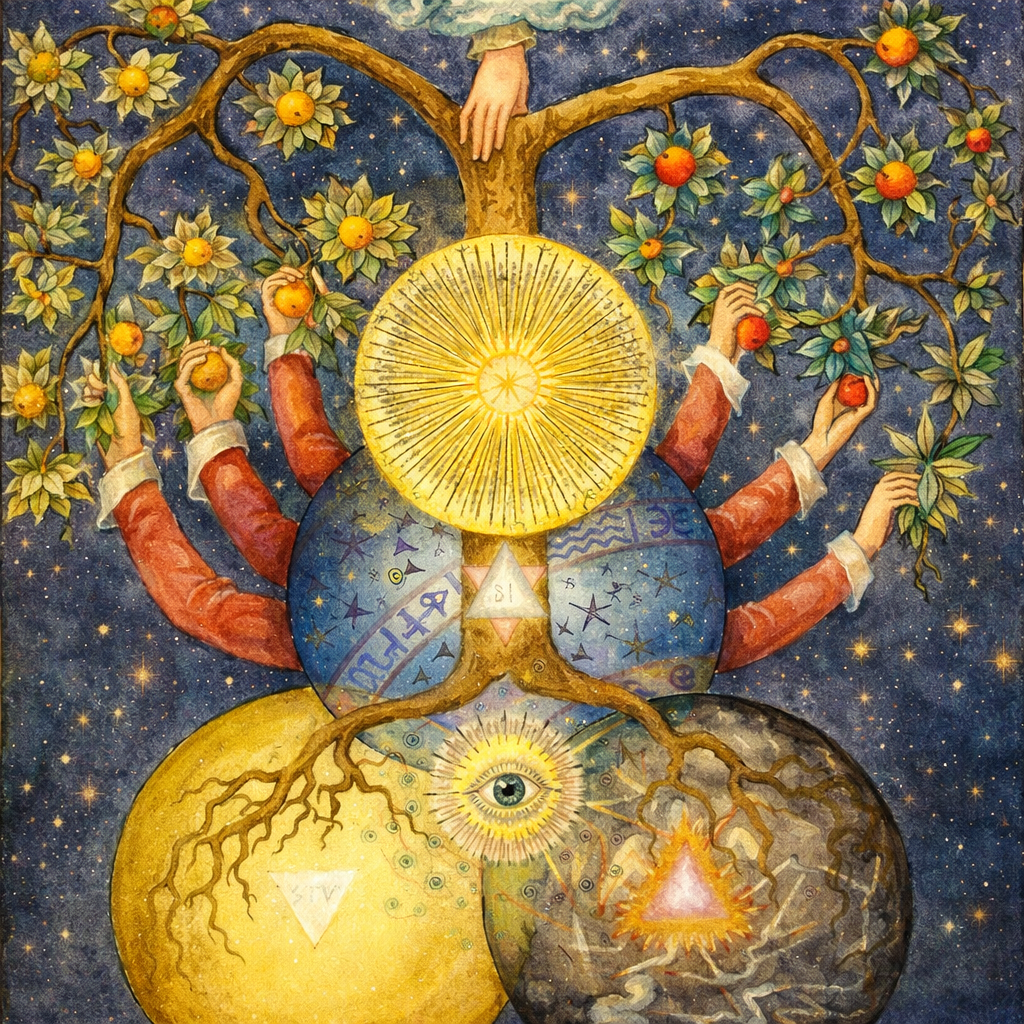
At the summit of Neoplatonic metaphysics stands the Prime Mover, the ineffable Source from which all existence flows. Below it descend successive levels of reality: intellect, soul, and matter. Each level is less unified, more differentiated, and further removed from the Source.
It is my opinion that Traditional Initiatory Witchcraft mirrors this structure internally through graded initiation and externally through ritual cosmology. Each degree represents not merely knowledge gained, but a shift in consciousness, a refinement of the soul’s capacity to perceive and participate in higher realities.
This structure parallels the Kabalistic Tree of Life, where divine emanation descends from the Crown through successive spheres until it reaches material existence. Both systems describe:
A descent of divine light
A fragmentation into multiplicity
And a path of return through conscious reintegration
Initiation, then, is not symbolic advancement. It is ontological recalibration, a gradual reorientation of the soul toward its origin.
When understood through Neoplatonism, Traditional Initiatory Witchcraft emerges not as a modern invention nor a cultural reenactment, but as a living theurgic system. Our Gods are real intelligences, our rites are acts of metaphysical alignment, and our initiations are stages in the soul’s ascent.
The Craft does not seek belief, conversion, or dogma. It seeks participation, direct engagement with the layered structure of reality and a conscious return toward the Source from which all things flow.
In this sense, Traditional Initiatory Witchcraft stands not outside Western metaphysical tradition, but firmly within its oldest and most esoteric current: the conviction that the divine may be known, touched, and embodied, here, now, and through disciplined ritual communion.
 A Witch Called By Love