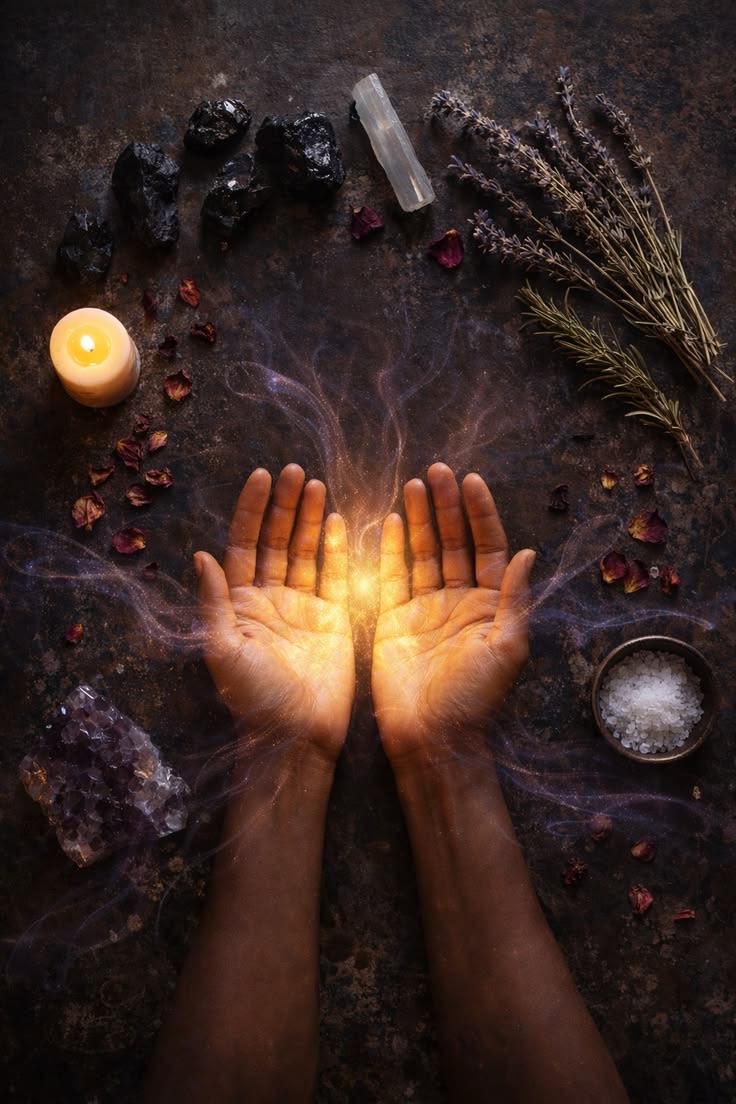
There is a persistent misconception that Witchcraft, particularly Wicca, involves casting harmful spells, manipulating others, opening spiritual portals, or attracting lower-vibrational entities. These assumptions deserve examination, particularly within the Reiki community, where healing, spiritual awareness, and personal responsibility are frequently emphasized.
Witchcraft should not be judged through fear or unfamiliarity. It should be understood on its own religious, philosophical, and historical terms.
Witchcraft is a practice; Wicca is a religion. Although closely related, they are not interchangeable. Not all Witches are Wiccan, and Witchcraft is practiced within numerous religious and secular frameworks. Wicca, particularly its initiatory traditions such as Gardnerian and Alexandrian, is a religious path centered on the Divine, commonly expressed through the Goddess and God, nature, ritual, and sacred Mysteries.
Spellcasting is not inherently harmful, manipulative, or an attempt to override another person’s free will. It can encompass prayer, focused intention, symbolic action, and the use of natural objects to facilitate protection, healing, blessing, and personal transformation. As with any spiritual discipline, ethical responsibility rests with the practitioner.
Nor is opening portals, summoning malevolent entities, or attracting lower-level spirits a defining characteristic of Wicca. Concepts such as vibrations, spiritual hierarchies, and entities belong to various esoteric belief systems, but they are not universal Wiccan doctrines. Applying another tradition’s spiritual classifications to Wicca without understanding its theology creates unnecessary confusion.
Interestingly, two respected authors provide particularly relevant perspectives on the relationship between these disciplines.
Diane Stein, author of Essential Reiki and Diane Stein’s Guide to Goddess Craft, explores the relationship between healing, Goddess spirituality, empowerment, and personal responsibility. Her work encourages an understanding of spirituality that recognizes the sacredness of life and the individual’s responsibility for their choices.
Christopher Penczak, a Witch, Reiki Master Teacher, and author of The Magick of Reiki, addresses this relationship directly. In his article Where the Paths of Paganism and Reiki Meet, he writes:
“The paths of magick and Reiki are not so different. They are both traditions available to all to enhance, heal, and empower yourself, no matter your personal path.”
Penczak explores the Witch as a bridge between the physical and spiritual worlds, with healing extending to people, the land, and the spirits. His work demonstrates that Reiki and Witchcraft are not necessarily opposing disciplines; they can be complementary practices within one person’s spiritual life.
There is also an important ethical distinction worth considering. Reiki practitioners are taught to respect personal boundaries and the recipient’s autonomy. These considerations are not foreign to Wicca. Many Wiccans place considerable importance on intention, consent, discernment, and responsibility for magical actions. Although ethical interpretations differ between traditions and practitioners, the assumption that Wiccans routinely seek to manipulate others is simply an unfair generalization.
A Witch is not automatically operating at a lower vibration because they practice magic. A Reiki practitioner is not automatically spiritually elevated because they practice energy healing. Neither a religious title nor a spiritual attunement guarantees wisdom, compassion, or ethical conduct.
We should be equally cautious about assuming that unfamiliar spiritual practices invite undesirable entities or create spiritual danger. Such claims require more than personal fear or terminology borrowed from another occult framework.
Reiki and Wicca have different histories, methods, and theological foundations. Reiki emphasizes healing through what practitioners understand as universal life energy; Wicca encompasses religious devotion, ritual, and, in many expressions, magical practice. Both can encourage spiritual development, self-awareness, and responsibility.
One does not have to embrace Witchcraft to respect it, just as one does not have to practice Reiki to acknowledge its significance to others.
A Reiki practitioner can be Wiccan. A Wiccan can be a Reiki Master. Neither identity invalidates the other.
Spiritual discernment should begin with understanding rather than assumption. If we genuinely believe that healing, compassion, and spiritual growth are worthwhile pursuits, those values should extend to how we speak about the spiritual paths of others.
Different traditions deserve to be understood on their own terms, not reduced to frightening stereotypes.
Different philosophies. Different methods. Different Mysteries. One Divine Source.



Leave a Reply